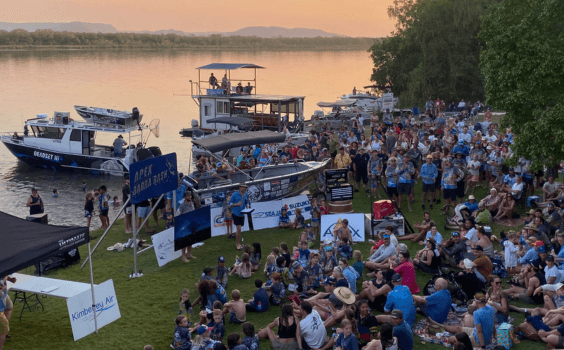
For five decades, the Dampier Classic has brought together generations of fishers around a shared love of fishing – and its 50th edition showed exactly why the competition remains such an important part of the Dampier community.
Run by King Bay Game Fishing Club, this year’s milestone Classic surpassed expectations, attracting 35 teams, 113 anglers and 35 boats in spectacular conditions.
And the fishing was equally impressive.

Across the competition, more than 650 fish were tagged, including an extraordinary 375 sailfish, as well as one marlin, 52 sharks and 223 other gamefish. Another 135 fish across 17 species were weighed in, with four potential Australian records recorded, three of which could also become IGFA world records.
A unique tournament
But for King Bay Fishing Club’s Mick Grasso (pictured with his avid fishing family below), the enduring success of the competition is about much more than the numbers.
“It’s a unique tournament – there are different categories, so there’s something there for everyone, and the fishing here is spectacular and varied with the islands,” Mick said.
“But more than that, it’s the camaraderie – it brings the town together.
“For a remote community like us, it’s a shared passion. Even if you don’t fish, you know someone who does and everyone comes down to have a look at the weigh-ins and for the presentation night.”
That connection across generations is something Mick has lived. He first fished the Classic when he was 12 and this year competed alongside his 16-year-old son and 12-year-old daughter with the family team winning their division for the second year in a row.
“I moved to Dampier with my family when I was nine and I’ve been fishing the comp since I was 12 and now I’m watching my kids come through as part of the next generation,” he said.
“That’s hugely rewarding to see and makes all the effort we put in even more worthwhile.”
The Classic began 51 years ago and has been held every year since apart from one missed event during COVID.
This year saw some of the strongest participation in years, with close to 40 boats compared with around 20 in a typical year – and Mick said many of the first-time entrants were already planning to return.